Field notes
Alcohol on the IMSAFE checklist is not a slider.
14 May 2026 · 8 min read · AngaBrief
The IMSAFE checklist presents six dimensions for a pilot to score before flight. Five of them are genuinely continuous: stress accumulates, fatigue deepens, illness worsens across a spectrum. Ordinal scores on a 1–5 scale are the appropriate tool for capturing the difference between "mildly tired after an early start" and "exhausted from a three-leg day." The instructor who reads those scores downstream can exercise judgement calibrated to magnitude.
Alcohol is different. The regulatory standard is not a spectrum. FAR 91.17 prohibits acting as a crew member within eight hours of consuming alcohol, while under the influence, or with a blood-alcohol concentration at or above 0.04%. KCAA Subpart 91.10 mirrors this with the same eight-hour rule and the same zero-tolerance-during-flight position. ICAO Annex 1 §1.2.7.1 prohibits the exercise of licence privileges when impaired by any psychoactive substance. Three separate regulatory instruments, all converging on a single binary answer: any positive indication means no flight.
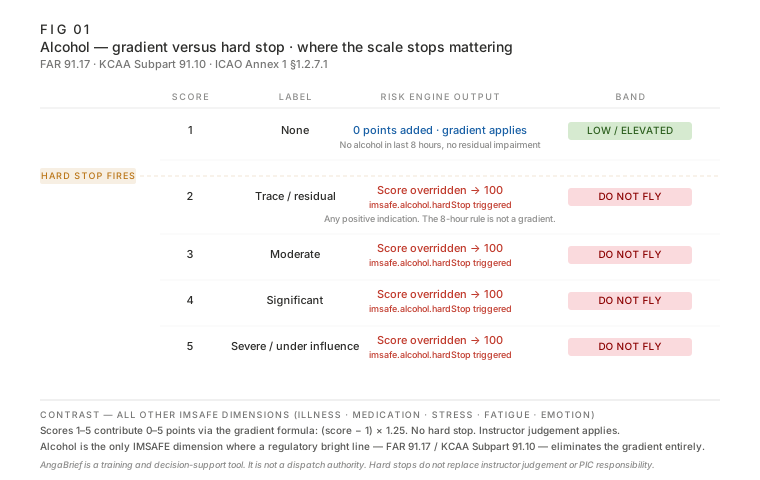
As of 14 May 2026, AngaBrief's risk engine enforces that binary. Any alcohol
score of 2 or above on the IMSAFE dimension triggers a hard stop:
evaluateHardStops() overrides the accumulated risk score to 100, forces the
band to do not fly, and records the factor label
imsafe.alcohol.hardStop — Alcohol indicated — DO NOT FLY (FAR 91.17 / 8 hours bottle-to-throttle) in the contributing-factors list. The gradient
is gone. No weighting, no accumulation, no instructor override path.
What the 1–5 scale was for
The IMSAFE wizard step presents a 1–5 ordinal scale for each dimension. For all six dimensions, score 1 means "none" — no impairment, no indication, nothing to declare. Scores 2 through 5 represent increasing severity.
For five of the six dimensions, that gradation is clinically and operationally meaningful. A pilot with mild nausea from a pre-existing gastric condition scores differently from a pilot with active malaria. A pilot under minor financial stress scores differently from one who has just received devastating personal news. The instructor uses the granularity.
For alcohol, the granularity is a fiction. Under FAR 91.17, score 2 — "trace / residual impairment, more than eight hours since any consumption" — is identical in legal effect to score 5, "currently under the influence." Both are prohibited. The difference between them matters for a medical discussion with a flight surgeon; it does not matter for the go/no-go decision the wizard is recording.
Worse, a gradient on alcohol creates a documentation liability. An assessment that records alcohol as score 2 out of 5 and proceeds to a low or elevated band carries a written statement that the student indicated some degree of alcohol impairment and was dispatched anyway. That is not a training record. That is an accident report waiting for its date.
Why the eight-hour rule is not a gradient
The eight-hour bottle-to-throttle interval in FAR 91.17 is a minimum, not a safe threshold. Alcohol metabolism is not uniform: body weight, liver function, metabolic rate, hydration status, and the type and volume of alcohol consumed all affect how quickly blood-alcohol concentration falls below 0.04%. Eight hours clears most volumes of most beverages for most adults — it does not clear a heavy evening for a fatigued student pilot of 60 kg.
ICAO Annex 1 §1.2.7.1 uses the phrase "impaired by any psychoactive substance" without specifying a threshold. The 0.04% BAC figure in FAR 91.17 is a minimum legal threshold — a pilot with a 0.03% BAC who demonstrably cannot perform their duties is still in violation under the "under the influence" language. The standard is performance-based; the number is a floor.
This is why IMSAFE's alcohol dimension is framed around residual impairment rather than a simple "did you drink?" binary. A pilot who consumed alcohol eleven hours ago and slept eight hours has met the eight-hour rule; whether residual impairment remains is a separate question. Score 1 — "none" — is the only appropriate self-declaration when the answer to both questions is negative: no consumption in the last eight hours and no residual impairment after that period.
Any other answer on an IMSAFE alcohol field should stop the assessment.
What the hard stop does and does not do
The evaluateHardStops() function runs before the PAVE environment and
external-pressure weights are accumulated. It is not the last step in a
pipeline that can be overridden by a high PAVE score pulling in the other
direction. It runs first, and its output is final.
When the hard stop fires:
- Risk score is set to 100.
- Risk band is set to
do_not_fly. - The contributing factor
imsafe.alcohol.hardStopis written to the assessment's contributing-factors array with the literal text "Alcohol indicated — DO NOT FLY (FAR 91.17 / 8 hours bottle-to-throttle)". - No other IMSAFE or PAVE factor is evaluated. The computation stops.
- The assessment is submitted to the instructor queue with that band and that factor visible on the card.
What the hard stop does not do:
- It does not prevent the student from submitting the assessment. Submission is preserved because the audit log entry — including the alcohol indication and the resulting band — is the regulatory artefact. A school that needs to document a student's self-reported alcohol indication for KCAA purposes requires that the record exists, not that it is suppressed.
- It does not trigger an automatic notification beyond the normal instructor
queue entry. The instructor sees the
do_not_flyband and the factor label. That is the signal. - It does not allow instructor override. Unlike the
overridden_to_gopath that exists for high-risk environmental assessments where a CFI's documented judgement is the appropriate response, the alcohol hard stop has no override path at the application layer. KCAA Subpart 91.10 is not a matter of instructor discretion.
The contrast with Stress and Emotion
It is worth stating plainly what the rest of the IMSAFE dimensions do, because the contrast clarifies the design logic.
Stress and Emotion are explicitly gradient items. AC 60-22 — the FAA Advisory Circular that codified IMSAFE — describes both as "consider" items, not "ground if present" items. A student whose grandmother died last week needs a conversation with their instructor, not an automatic block. The instructor may approve the flight, request a shorter route, reassign to a dual sortie, or recommend postponement. That judgement is exactly what the gradient supports.
Fatigue and Illness occupy a middle position. Neither carries a regulatory bright line equivalent to FAR 91.17. The KCAA syllabus and FAR 61.53(a) require the PIC to not exercise privileges during a "known medical deficiency" — but what constitutes a deficiency at any given fatigue or illness level is a medical judgement, not a numeric threshold. The engine's gradient handles this correctly: a score of 4 or 5 will accumulate enough IMSAFE points to push most assessments into the high band, prompting an instructor conversation, without removing the instructor's authority to decide.
Medication and Illness have stronger cases for hard stops at the extreme end of the scale — the research underpinning this engine flags both as candidates for tighter enforcement in a future engine revision. Neither is live yet.
Alcohol has none of this ambiguity. FAR 91.17 provides the bright line. The engine respects it.
What this means for Kenyan training operations
The eight-hour rule is well understood in Kenyan aviation culture. KCAA Subpart 91.10 is not an obscure provision. The practical failure mode is not ignorance of the rule — it is the social pressure to score the dimension charitably when the student knows the answer is not 1 but fears the consequence of honesty.
That pressure is exactly what a structured digital assessment addresses. The wizard asks the question explicitly, in a scored field, and the resulting record is the permanent audit-log entry that an ATO must produce for KCAA inspection. A student who scores 1 on alcohol when the honest answer is 2 is not just making a personal decision — they are creating a false document in a KCAA-inspectable record.
The hard stop does not compel honesty. No software does. What it does is remove the incentive for a school to construct a plausible-looking assessment around a compromised alcohol score. If the score is 2 or above, the record says DO NOT FLY. The instructor sees it. The audit log carries it. The document is what it is.
For most training days at most Kenyan ATOs, the alcohol hard stop will never fire. Kenyan training operations run early mornings; the student cohort skews young and predominantly abstinent. The hard stop's presence is not a statement about the culture of any particular school. It is a statement that the regulatory standard is absolute, and the tool that records compliance with that standard should reflect the absoluteness of the rule.
What this is not
- Not a breathalyser substitute. The score is a self-report. The wizard cannot verify it. The instructor's pre-flight conversation and direct observation remain the physiological cross-check that the software cannot replace.
- Not a medical determination. The hard stop fires on a score of 2 — "any indication" — rather than attempting to model whether residual BAC is above or below 0.04%. That computation would require inputs the wizard does not collect and a medical authority the tool does not hold.
- Not a new standard. The FAR 91.17 eight-hour rule has been in force since 1959. KCAA Subpart 91.10 mirrors it. This is an enforcement of an existing standard, not the introduction of a new one.
AngaBrief is a training and decision-support tool. It is not a dispatch authority. Final go/no-go authority rests with the Pilot in Command and the assigned Flight Instructor in accordance with KCAA regulations. AngaBrief does not replace official weather briefings, NOTAM checks, aircraft documentation review, or instructor judgement.