
Field notes
IMSAFE for the Kenyan training environment.
11 May 2026 · 5 min read · AngaBrief
IMSAFE — Illness, Medication, Stress, Alcohol, Fatigue, Emotion — is the self-assessment a PIC runs against themselves before every flight. The KCAA student-pilot syllabus mandates it; every ATO operations manual embeds it; every paper pre-flight checklist still in use carries it on the back. It is also the most under-scored block on those paper checklists, because the format records the tick, not the score.
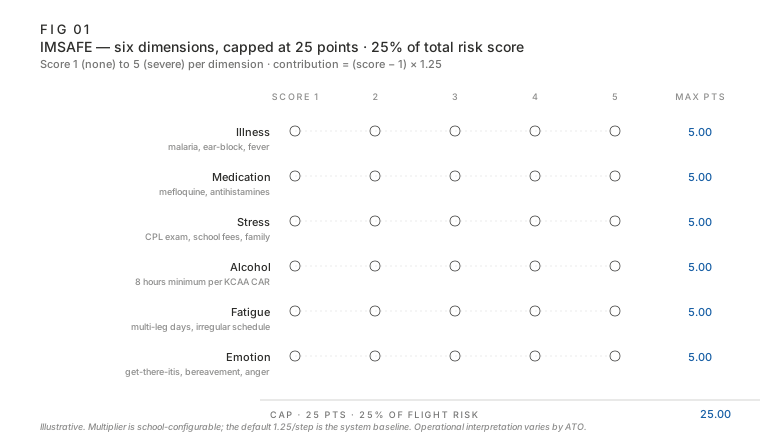
Step 4 of the AngaBrief assessment wizard surfaces IMSAFE as six scored dimensions, 1 (none) to 5 (severe), with optional notes. The combined total contributes 25% of the flight risk score — the largest single contributor in the engine — and is preserved on the assessment, the exported PDF, and the audit-log entry that survives KCAA inspection.
What it computes
Each dimension is scored on a 5-point ordinal scale. The risk engine converts that score to a point contribution using:
contribution_per_dimension = (score − 1) × 1.25     // 0–5 points
imsafe_total = Σ contributions                       // 0–25 points
A perfect IMSAFE profile — 1 across all six dimensions — contributes zero to the risk score. A worst-case profile — 5 across all six — contributes 25 points, which is enough alone to push a low-risk flight into the elevated band before any PAVE factor is computed.
The weights are school-configurable. The risk_weights JSON column on the
schools table carries the multiplier; the default value of 1.25 per
ordinal step is the system baseline. A school that wants IMSAFE to weigh
more heavily can raise the multiplier; one that wants to weight environmental
factors more heavily can lower it. The audit log records both the
configuration in force at the time of submission and the resulting score —
inspection-grade traceability.
Why it matters operationally
The KCAA pre-flight syllabus does not specify how IMSAFE should be recorded, only that it should be performed. The practical result on most ATO paper checklists is a six-line block with binary ticks: did you check? Yes / No. The instructor signs the bottom and the artefact is filed.
That format loses three things an inspector or an insurer cares about:
- The magnitude per dimension. A 2/5 fatigue on a routine circuit is different from a 4/5 fatigue before a 200 nm cross-country.
- The notes that explain the score. "Slept 4 hours due to thunderstorms over the school dormitory" reads differently from "tired".
- The aggregate that contributes to the go/no-go. Without the per-dimension scores the aggregate cannot be computed; without the aggregate the IMSAFE block is decorative, not decisional.
The wizard's structured form addresses all three: ordinal score, optional note, computed aggregate. The instructor reviewing the queue sees the full breakdown before deciding.
The six dimensions in Kenyan context
Each dimension has a regulator-grade definition. The operational reading shifts depending on where in the world the training happens. The considerations that bear on Kenyan operations:
- Illness. Malaria remains endemic in coastal and lake-region catchment areas served by HKMO, HKKI, HKLU, HKML, and HKUK. A student presenting with early-symptom malaria — headache, mild fever, joint pain — should be scoring at least 3, and the instructor should be reviewing. Common colds and ear infections are routinely scored low (1–2) but become 4+ for any flight involving climbs above 8 000 ft due to ear-block risk.
- Medication. Malaria prophylaxis (mefloquine, doxycycline,
atovaquone-proguanil) is in routine use among East African pilots and
carries varying side-effect profiles for cockpit work. Mefloquine in
particular has documented neurological side effects that should never
score below 3 for the first two weeks of a new prescription. Antihistamines,
anti-emetics, and most cough syrups carry sedative warnings; KCAA does
not maintain its own list, but ICAO
Annex 1 §6.3.1defers to ICAO Manual of Civil Aviation Medicine for guidance. - Stress. CPL exam blocks, school-fee deadlines (KES 800 000–1.2 m per CPL course), and family obligations during heavy harvest months are the three dominant stress sources for Kenyan training. None of these reduces with pre-flight breathing exercises; they are scored honestly or not scored at all.
- Alcohol. KCAA Civil Aviation Regulations specify an 8-hour minimum bottle-to-throttle interval, with zero tolerance during flight. The IMSAFE score reflects residual impairment after the 8-hour mark; a heavy evening followed by an 8-hour rest is not a 1.
- Fatigue. Training operations frequently run multi-leg days. A student flying three solo circuits in the morning, a cross-country dual after lunch, and a checkride preparation slot in the late afternoon should not be scoring fatigue as 1. The wizard surfaces this even when the student is reluctant to admit it — the instructor sees the score and can recalibrate before the third sortie.
- Emotion. Get-there-itis, family bereavement, recent argument, exam pressure. The emotional state of the PIC is the single highest correlation with judgement-error accidents in general aviation; the IMSAFE dimension is the field record of the candid answer.
How AngaBrief surfaces it
Step 4 of the assessment wizard presents the six dimensions as a single form: ordinal score (1–5) on the left, free-text notes on the right, one row per dimension. Saves persist across step transitions.
On submission, per-dimension scores are written to the imsafe_responses
JSONB column on the assessments table. The risk engine reads the same
column; the assessment view and the exported PDF render the full
breakdown — score and notes per dimension — alongside the IMSAFE total.
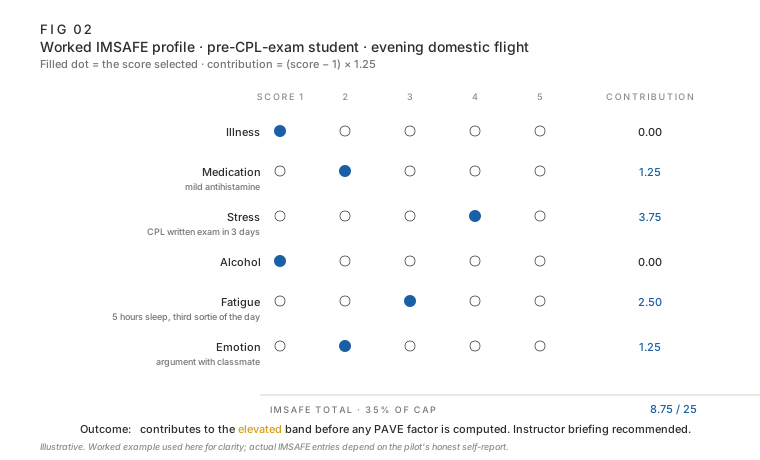
The risk gauge displays IMSAFE as one of the contributing factors. The score is never displayed without the per-dimension breakdown, because opacity in a risk score is what makes pilots ignore it. An instructor reviewing the queue sees Illness 1 · Medication 2 · Stress 4 · Alcohol 1 · Fatigue 3 · Emotion 2 before deciding, not just a single IMSAFE 8.75.
What this is not
- Not a medical authority. The IMSAFE score is a self-report. A pilot scoring 1 on Illness while concealing malaria symptoms is making a decision the wizard cannot verify. The instructor's pre-flight chat remains the cross-check that catches concealed scores.
- Not a substitute for the Aviation Medical Examiner. Class 1, 2, and 3 medicals issued by KCAA-approved AMEs are the substrate; IMSAFE is the flight-by-flight overlay. Both are required, neither replaces the other.
- No biometric integration. Smartwatch sleep data and heart-rate variability are not wired into the IMSAFE dimension. Manual entry is the deliberate design choice: it captures the moment the pilot last consciously reflected on their state.
Disclaimer
AngaBrief is a training and decision-support tool. It is not a dispatch authority. Final go/no-go authority rests with the Pilot in Command and the assigned Flight Instructor in accordance with KCAA regulations. AngaBrief does not replace official weather briefings, NOTAM checks, aircraft documentation review, or instructor judgement.