
Field notes
Density altitude at Kenyan aerodromes: when the climb chart lies.
10 May 2026 · 5 min read · AngaBrief
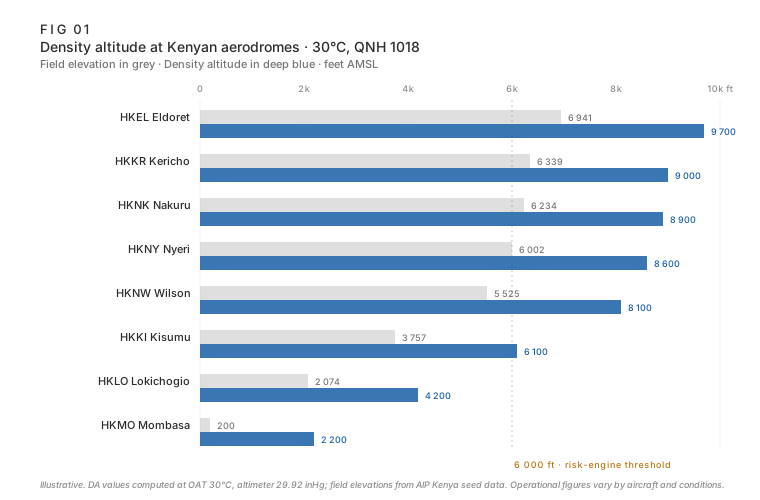
Density altitude is the altitude an aircraft thinks it is operating at — pressure altitude corrected for non-standard temperature. On the Kenyan plateau it bites every flight. Wilson sits at 5 525 ft of field elevation, Eldoret at 6 941, Nakuru at 6 234, Nyeri at 6 002. On a 30°C afternoon, density altitude at Wilson exceeds 8 000 ft. At Eldoret it brushes 9 700 ft.
The performance penalty is non-linear and compounds across takeoff roll, climb rate, and true airspeed simultaneously. The same Cessna 172 that rotates in 580 m at sea level on a standard day needs roughly twice the runway at Eldoret on a hot afternoon, and produces less than a third of its book climb rate to clear obstacles.
What it computes
Density altitude is pressure altitude adjusted for ISA temperature deviation.
The standard general-aviation approximation, referenced in ICAO Doc 7488
and most GA POHs:
DA ≈ PA + 120 × (OAT − ISA_temp_at_PA)
PA = field_elev + (29.92 − altimeter_inHg) × 1000
ISA_temp_at_PA = 15°C − 2°C / 1 000 ft × PA
The 120 ft/°C constant is sufficient for briefing precision across the temperature ranges typical at Kenyan aerodromes (15–35°C). Navigation-grade work would use the full ISO 2533 atmosphere model; briefing-grade work uses the approximation above. The function lives in the assessment wizard's performance module and is exercised in unit tests against worked POH examples.
| ICAO | Aerodrome | Field elev. (ft) | DA at 30°C, QNH 1018 |
|---|---|---|---|
| HKEL | Eldoret | 6 941 | ~9 700 |
| HKKR | Kericho | 6 339 | ~9 000 |
| HKNK | Nakuru | 6 234 | ~8 900 |
| HKNY | Nyeri | 6 002 | ~8 600 |
| HKNW | Wilson | 5 525 | ~8 100 |
| HKKI | Kisumu | 3 757 | ~6 100 |
| HKLO | Lokichogio | 2 074 | ~4 200 |
| HKMO | Mombasa Moi | 200 | ~2 200 |
The four coastal aerodromes (Mombasa, Malindi, Lamu, Ukunda) are effectively sea-level operations. Everywhere else in Kenya, density altitude is the dominant performance variable on every flight, every day.
Why it matters operationally
The KCAA cross-country syllabus and most ATO operations manuals require a
density-altitude computation as part of the pre-flight briefing for any
aerodrome above 4 000 ft of elevation. Examiners ask for it. Insurance
binders ask for it. ICAO Annex 6 Part II §2.2.3.5 lists it explicitly as
a pilot-in-command responsibility for general-aviation operations.
For a normally-aspirated piston aircraft, the operational rules of thumb at briefing-grade precision:
- Takeoff distance rises roughly 10% per 1 000 ft of density altitude. From Eldoret on a 30°C afternoon, a Cessna 172 needs close to twice the published sea-level takeoff roll.
- Climb rate falls roughly 8% per 1 000 ft of density altitude. A C172 advertising 720 fpm sea-level climb produces under 250 fpm at Eldoret on the same afternoon — before considering aircraft weight, wind, or passenger load.
- True airspeed rises about 2% per 1 000 ft of density altitude at a given indicated airspeed. The aircraft is moving faster across the ground than the ASI suggests; the same indicated approach speed lands harder, the same indicated rotation speed crosses the threshold sooner.
- Cruise fuel burn for a given indicated airspeed rises 5–8% over the highlands. The route briefing's default 30 l/hr for a C172 holds at sea level; over the Rift it is closer to 32 l/hr at the same RPM, eroding fuel margin without showing on the airspeed indicator.
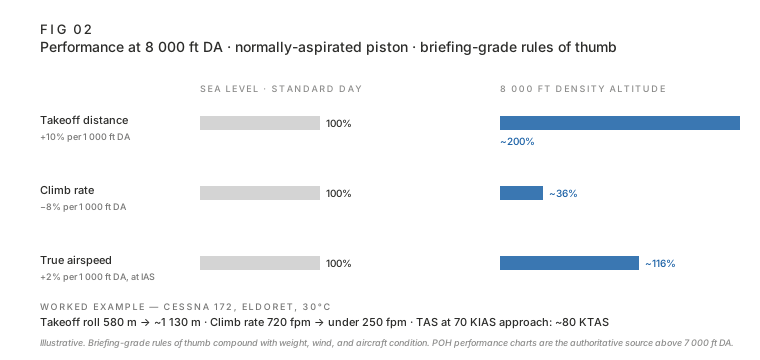
The compounding effect — longer roll, slower climb, faster ground speed — is what drives the post-departure stall and obstacle-strike sequences that appear in every regional accident summary. Density altitude is briefable. Most accidents that involve it were preceded by a pre-flight worksheet that did not compute it.
How AngaBrief surfaces it
Step 7 of the assessment wizard — Environment — collects the QNH (in inches of mercury), the OAT (in °C), and the runway in use. The pure function in the performance module returns:
- Pressure altitude
- ISA temperature at that pressure altitude
- ISA deviation
- Density altitude
These appear on the assessment view, on the exported PDF alongside the crosswind-component computation for the runway in use, and feed the risk engine. Density altitude over 6 000 ft contributes +5 to the PAVE Environment factor band; the threshold sits intentionally below the operational pain point so that a Wilson afternoon flight in a fully loaded C172 nudges the score into the elevated band, prompting an instructor briefing rather than a silent dispatch.
The contributing factor appears on the risk gauge with the literal density altitude value next to it. The score is never displayed without the operational reasons that produced it. When an instructor approves a flight with density altitude over 8 000 ft, the audit log retains both the value and the approval. KCAA inspections that turn on weather-day decision-making have the artefact they need without the operator producing it on demand.
What this is not
- Not a substitute for a POH performance check. The rules of thumb above are conservative averages. An aircraft 50 hours past its propeller overhaul, or operating with a stiff cylinder head, will underperform them. When density altitude is operationally significant (above 7 000 ft), the POH performance chart for the specific aircraft, weight, and configuration is the source.
- Not a takeoff distance calculator. Density altitude is computed and surfaced; takeoff distance for a specific aircraft weight, runway slope, surface, and headwind is not. That computation belongs in the dispatch worksheet on the POH performance pages.
- Not a substitute for the KMD altimeter setting. The wizard uses the QNH the student enters. If the entered QNH drifts from the active KMD setting, the computed density altitude drifts too. A current QNH before submission is the student's responsibility — manual entry is the design choice, not an oversight.
- No automatic temperature fetch. Outside air temperature is manual entry. Adding live temperature ingestion is a v2 consideration; the manual field surfaces the moment the student last actually read the thermometer, which is the operational signal an examiner cares about.
Disclaimer
AngaBrief is a training and decision-support tool. It is not a dispatch authority. Final go/no-go authority rests with the Pilot in Command and the assigned Flight Instructor in accordance with KCAA regulations. AngaBrief does not replace official weather briefings, NOTAM checks, aircraft documentation review, or instructor judgement.