
Field notes
Cross-country in Kenya: what the route briefing computes.
10 May 2026 · 4 min read · AngaBrief
A cross-country flight test in Kenya is judged on the briefing as much as on the flight. KCAA examiners look for a leg-by-leg breakdown of the route, a documented en-route alternate, and a fuel margin that survives a mid-leg divert. Step 3 of the assessment wizard — Aerodromes and route — produces all three from the waypoints the student enters.
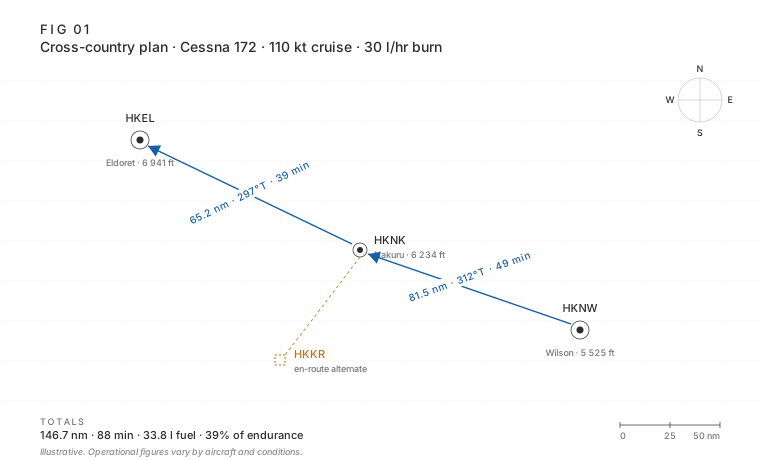
What the wizard computes
The student enters intermediate waypoints in flight order — one ICAO per line — between the departure and the destination. The system looks each ICAO up against the seeded AIP Kenya aerodrome database and produces, for every leg:
- Distance in nautical miles, computed via the haversine formula on the waypoints' decimal-degree coordinates. For Kenyan VFR cross-country leg lengths (50–200 nm), the great-circle distance differs from the rhumb line by less than 0.1 nm — sufficient for a planning brief.
- True track in degrees true, computed as the initial bearing between the two endpoints. The conversion to magnetic uses the local magnetic variation carried in each aerodrome record (typically 1–3°W across Kenya).
- Estimated time enroute in minutes, derived as
distance ÷ cruise_kt × 60. Cruise speed defaults to the aircraft type code (C152: 100 kt, C172: 110 kt, PA-28: 115 kt) and can be overridden per assessment. - Total fuel required in litres, derived as
total_ETE ÷ 60 × fuel_burn_lph. Burn rates default the same way (C152: 23, C172: 30, PA-28: 34 l/hr).
These are briefing-grade figures, not navigation-quality. They surface whether the planned cruise speed makes the day's flight legal, comfortable, and within the aircraft's endurance. They do not replace the dispatch worksheet, the POH performance tables, or the instructor's approval.
The fuel-margin flag
When the student enters the aircraft's endurance — usable fuel in litres — the wizard computes the margin: total fuel required divided by endurance. The wizard, the assessment view, and the exported PDF all flag any plan where the margin exceeds 85% of endurance.
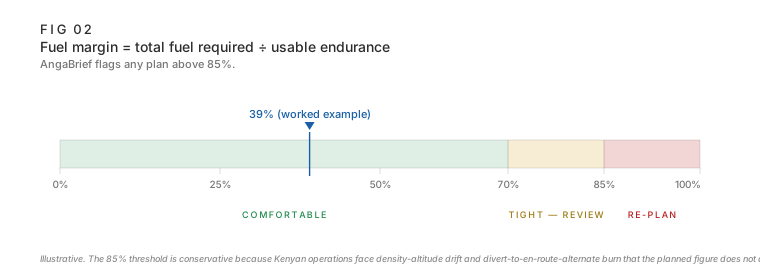
The 85% threshold is conservative because Kenyan operations face two specific traps:
- Density altitude. Wilson sits at 5 525 ft of pressure altitude on a standard day; a 30°C afternoon pushes the density altitude past 8 000 ft. Climb rates fall, true airspeed shifts, and fuel burn for a given indicated airspeed creeps up. The 15% reserve buffer absorbs that drift.
- Diversion to en-route alternate. Sixty nautical miles into a leg, the destination ceiling drops below minima. The PIC turns for HKKR or HKKI — that is another 30–40 nm of fuel that was not in the original plan. The margin makes that decision survivable.
If the margin runs over 85%, the briefing prints "Tight — review reserves with your instructor." This is a soft flag. The instructor still decides.
Destination alternate vs en-route alternate
KCAA cross-country examiners expect both alternates on a documented briefing:
- Destination alternate. A second aerodrome near the destination that the PIC can reach if the destination is unusable on arrival. Standard PPL/CPL syllabus.
- En-route alternate. An aerodrome along the route — usually around the midpoint — where the PIC can divert if weather or aircraft trouble develops during the leg. Examiners on cross-country flight tests routinely ask candidates which en-route field they would turn for at the halfway point.
Both fields are separate columns on the assessment row, separate cells on the exported PDF, and separate entries on the audit-log payload. Conflating them — by recording only the destination alternate — is the single most common briefing failure on a cross-country flight test.
What this is not
A few deliberate exclusions:
- No automatic enroute weather along the route. The wizard's "fetch live METAR" button pulls the latest observation for the departure aerodrome from the NOAA aviation-weather feed. Enroute weather is briefed against KMD products, not auto-pulled by AngaBrief. The regulator's accepted source is KMD.
- No POH-derived performance corrections. Cruise speed and fuel burn defaults are general-aviation averages. An aircraft 5 kt slower at 8 000 ft density altitude with a stiff prop will breach those defaults silently. If the margin is borderline, fall back to the POH and override the cruise speed in the wizard.
- No airways, SIDs, STARs, MEAs, or MOCAs. The route briefing is a VFR cross-country planning aid. IFR airway planning, procedural minima, and Standard Instrument Departures belong in IFR-rated tooling and on a different KCAA conversation.
How to use it on a flight test
- Plan on paper first. Sectional out, plotter on the waypoints, fuel computer for the burns. The wizard is the second pass that surfaces what was missed, not the first.
- Enter the waypoints in order. One ICAO per line in step 3. Override the cruise/fuel defaults if the aircraft is non-standard.
- Add an en-route alternate. Even if it is the obvious one. The recorded fact that an en-route alternate was identified is the artefact the examiner is looking for.
- Read the fuel margin out loud during the briefing. If it is over 80% even before the 85% flag fires, talk through the diversion plan with the instructor before submitting.
Disclaimer
AngaBrief is a training and decision-support tool. It is not a dispatch authority. Final go/no-go authority rests with the Pilot in Command and the assigned Flight Instructor in accordance with KCAA regulations. AngaBrief does not replace official weather briefings, NOTAM checks, aircraft documentation review, or instructor judgement.